
DLSS 5 is here. Should it change what graphics card you buy?
NVIDIA's DLSS 5 makes games look more real, but it costs roughly half your frame rate, and only one game has it officially. Mods put it anywhere, at a price. What it actually means for you, card by card, before you spend money on it.
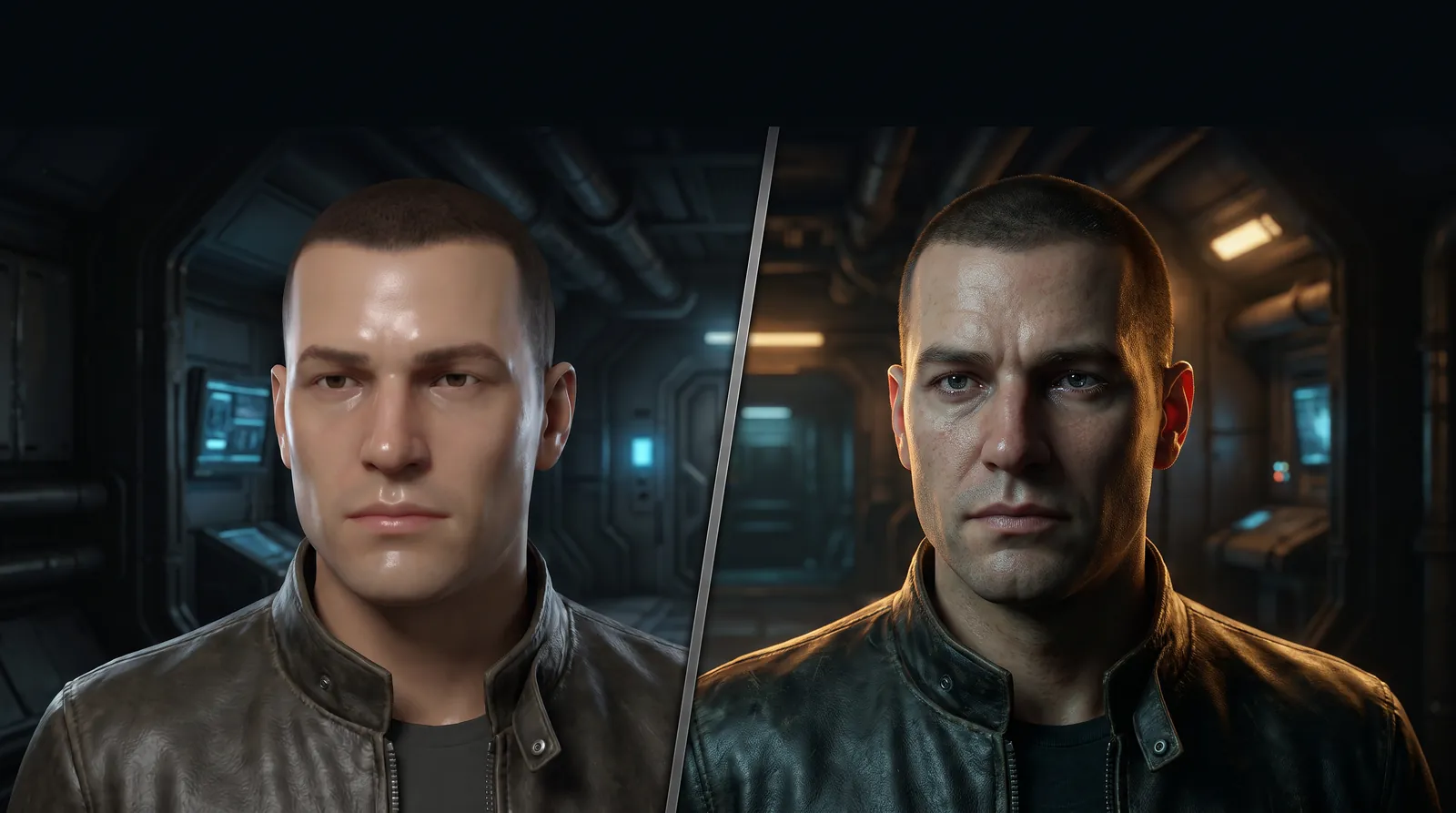
No, not yet. DLSS 5 launched on 3 September 2026 with official support in one game, NBA 2K27, on RTX 50 Series cards. Modders have already pushed it into almost any PC game and onto older RTX cards, so you can try it today. Turned on, it makes lighting and skin look noticeably more real, but it costs about half your frame rate on every card that has been tested, from the RTX 5060 to the RTX 5090. Buy the card that runs the games you play today. DLSS 5 is a bonus, not a reason to pay for a card.
That is the short version. The rest of this post is what it looks like in practice, how to try it in your own games right now, what it does to the cards most people actually buy, and when it is worth switching on.
What DLSS 5 does, in plain words
Every DLSS before this one was about speed. DLSS 2 drew the game at a lower resolution and cleverly scaled it up. DLSS 3 and 4 added frame generation, where the card invents extra frames between the real ones so motion feels smoother. Both of them gave you more frames per second for free, more or less.
DLSS 5 is the opposite trade. NVIDIA calls it 3D-Guided Neural Rendering. It takes the finished frame the game drew and runs it through an AI model that adds lighting and material detail the game engine never rendered: how light scatters under skin, the sheen on a jersey, small contact shadows where a foot meets the floor. The model works one frame at a time and stays anchored to what the game drew, so it is not inventing new objects, just relighting the ones that are there. The developer tunes how far it goes.
The catch is that this is extra work, on top of rendering the game. NVIDIA's own launch post says it expects "upcoming model updates coming in the Fall to boost performance beyond today's baseline", which is a polite way of saying the first version is heavy.
What it costs in frames
NVIDIA's launch numbers look enormous because they are measured with DLSS Super Resolution and 6x Multi Frame Generation switched on: 370 fps at 4K on an RTX 5090, 260 fps at 1440p on an RTX 5070. Those are real numbers, but five of every six frames are generated, and they hide what DLSS 5 itself costs.
Digital Foundry measured the cost directly by toggling DLSS 5 on and off in NBA 2K27 with everything else unchanged:
| Card | Setting | DLSS 5 off | DLSS 5 on | Cost |
|---|---|---|---|---|
| RTX 5090 | 4K, Ultra | 128 fps | 63 fps | 51% |
| RTX 5080 | 4K, Ultra + RT | — | just over 40 fps | 58% |
| RTX 5070 | not stated | — | — | 55% |
| RTX 5060 | not stated | — | — | 41% |
Source: Digital Foundry's NBA 2K27 testing, reported by Notebookcheck, September 2026. Blank cells are figures the report did not publish.
Read that table as a gamer, not a reviewer. A card that comfortably does 120 fps in a game will do about 60 with DLSS 5 on. Frame generation can bring the number on the counter back up, but generated frames add a little input delay, and early tests on other titles have measured system latency climbing from around 40 ms to 65 ms with the feature engaged. For a basketball game that is fine. For a competitive shooter you would never leave it on, and none of the announced shooters have shipped support yet anyway.
Where it is available officially
- Games: NBA 2K27 today. NVIDIA has named around sixteen more, including Starfield, Resident Evil Requiem, Assassin's Creed Shadows, Hogwarts Legacy, Delta Force and The Elder Scrolls IV: Oblivion Remastered, with no dates. When a game adds it, it appears as a "DLSS Neural Rendering" toggle in the game's video settings and you can turn it off at any time.
- Cards: every GeForce RTX 50 Series desktop and laptop card, RTX 5050 upward, on Game Ready driver 616.64 or newer. It also works on GeForce NOW Ultimate, which streams from RTX 5080 rigs.
- RTX 40 Series: NVIDIA has said it plans to bring DLSS 5 to RTX 40 after it finishes tuning the model for RTX 50. There is no date. RTX 30 and older are not mentioned at all.
NVIDIA has also confirmed there will be no "DLSS 5 override" switch in the NVIDIA app. Officially, a game gets it when its developer adds it, and not before.
The unofficial route: any game, today
Within days of launch the modding community had DLSS 5 running in games NVIDIA never touched. Tools like DLSS 5 Swapper and DLSS5oneclick take a leaked build of the neural-rendering runtime and inject it into almost any DirectX 11 or 12 game. For games that already have DLSS, it hooks into the existing DLSS path. For games that never had DLSS at all, a companion mod fakes the inputs DLSS needs, using ReShade to pull depth and motion data from the game. People have run it in Forza Horizon 5, Stalker 2, older DirectX 9 games and even console emulators. It also runs on RTX 20, 30 and 40 cards, which NVIDIA does not support yet.
It is genuinely impressive, and if you are curious it is the fastest way to see what all the fuss is about. Before you install anything, know what you are signing up for:
- The frame-rate cost is the same or worse. Over half your fps on RTX 50. On RTX 20 and 30 cards the tool authors themselves call the cost "heavy"; early reports had most games in the single digits on older cards and around 40 fps at best on high-end ones.
- Anti-cheat will ban you. Easy Anti-Cheat and BattlEye see injected files as cheating. Do not use it in any online game. The tools refuse to install into protected titles for exactly this reason.
- It is a leaked, unfinished build. The runtime is closed-source with no licence, output can drift from what the developer intended, and users report crashes, black screens and problems with alt-tab and resolution changes. Use borderless window, back up game files, expect breakage.
- It only works in real-time on the same card. One mod moves the AI work to a second graphics card to cut the cost, which is clever and also not a thing anyone with one card can use.
Our read: try it in a single-player game you love, take your screenshots, and turn it off. It is not a feature you leave running, and it is not a reason to buy or skip any card.
What it means for you, by budget
Entry gaming PC, roughly ₹70,000 to ₹90,000 (RTX 5060 or RX 9060 XT). Nothing changes. Both cards are bought for 1080p and 1440p frame rates in the games you already play. The 5060 gets DLSS 5 and the AMD card never will, but at this tier the frame-rate cost means you will try it once in NBA 2K27, enjoy the screenshot, and turn it off. Choose between them on price and the games you play, the way you would have last month.
The mid-range, roughly ₹1,00,000 to ₹1,30,000 (RTX 5060 Ti 16 GB or RTX 5070). Still the sweet spot, and still for the same reasons: 16 GB of memory on the 5060 Ti, strong 1440p, DLSS 4 frame generation that costs you very little. A 5060 Ti that does 90 fps at 1440p in a heavy game becomes a 50 to 55 fps card with DLSS 5 on. It will run it; you will not leave it on in most games. It is a nice extra in single-player titles where 60 fps is enough, and not a reason to stretch from a 5060 Ti to a 5070. The finished machines on our recent builds page show what each of these cards is set up to run.
₹1,50,000 and up (RTX 5070 Ti, RTX 5080). This is the first tier where DLSS 5 is genuinely usable, because these cards have frames to spare. A 5070 Ti doing 140 fps in a story game can give up half of that and still feel smooth, and with frame generation on top it looks as good as anything on a console. If you play mostly cinematic single-player titles at 1440p, this is where the feature earns its place. It is still not worth buying a 5080 over a 5070 Ti for.
RTX 5090. If you are here you already know. It runs everything, DLSS 5 included, at 4K. It is also several times the price of a 5070 Ti for a difference you will notice mostly in screenshots.
When the honest answer is "don't"
- Don't upgrade an RTX 40 card for DLSS 5. A 4070 Super or 4080 is still an excellent card, RTX 40 support is promised, and the feature is in one game.
- Don't pick NVIDIA over AMD because of it. The RX 9060 XT and RX 9070 XT are strong cards for the money. If DLSS 5 is the only thing tipping you towards NVIDIA, it is not enough of a thing yet.
- Don't expect it in the games you play online. Valorant, Counter-Strike, Fortnite and GTA Online are not on the list, and the modded route gets you banned there. Competitive games are the last place you would want the latency anyway.
- Don't pay for it in a laptop. Laptop RTX 50 cards have less headroom than desktop ones and the frame-rate cost is the same.
Summary
- DLSS 5 makes games look more real by adding lighting and material detail with AI. It is a look feature, not a speed feature.
- It costs about half your frame rate on every card tested, RTX 5060 through RTX 5090. Frame generation can mask that on the counter, with a small latency cost.
- One game supports it officially today, about sixteen more are announced without dates, and mods already put it in almost any single-player game, at the same cost and with anti-cheat and stability risks.
- Every RTX 50 card runs it officially. RTX 40 is promised, undated. Mods run it on RTX 20 upward. AMD cards never will.
- The cards most people buy, the 5060 and 5060 Ti, run it but have the least room for it. It gets genuinely usable from the 5070 Ti up.
- Buy for the games you play at the frame rate you want. Treat DLSS 5 as a free extra on an RTX 50, and revisit this when the fall optimisation update and more games land.
If you are choosing between two cards for a build and want a straight answer for your games and your budget, ask us for a quote. We will tell you when the cheaper card is the right one. That is most of what the custom PC service is.
Sources: NVIDIA's DLSS 5 launch post and Game Ready driver notes; Digital Foundry's NBA 2K27 measurements as reported by Notebookcheck; Corsair's DLSS 5 explainer; PC Guide and AltChar for the announced games list; Wccftech for NVIDIA's RTX 40 statement; VideoCardz on NVIDIA ruling out an app override; TechPowerUp, TweakTown and the DLSS5oneclick project page for the modded route and its warnings; Tom's Hardware for the RTX 30 mod frame rates. All September 2026.